

Health Library
Cold intolerance
Sensitivity to the cold; Intolerance to cold
Cold intolerance is an abnormal sensitivity to a cold environment or cold temperatures.
Images
I Would Like to Learn About:
Considerations
Cold intolerance can be a symptom of a problem with metabolism.
Some people (often thin older women) do not tolerate cold temperatures because they have very little body fat to help keep them warm.
Causes
Some causes of cold intolerance are:
- Anemia
- Anorexia nervosa
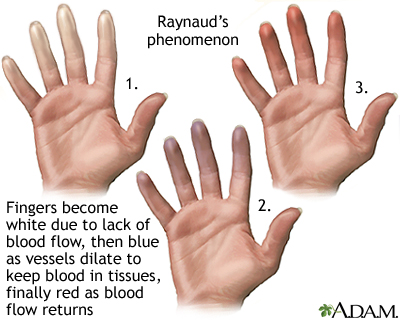
- Blood vessel problems, such as Raynaud phenomenon
- Chronic severe illness
- General poor health
- Problem with the hypothalamus, (a part of the brain that controls body temperature)
- Underactive thyroid (hypothyroidism)
Home Care
Follow the recommended therapy for treating the cause of the problem.
When to Contact a Medical Professional
Contact your health care provider if you have long-term or extreme intolerance to cold.
What to Expect at Your Office Visit
Your provider will take a medical history and perform a physical examination.
Your provider's questions may include the following topics.
Time pattern:
- Have you always been intolerant of cold?
- Has this developed recently?
- Has it been getting worse?
- Do you often feel cold when other people do not complain of being cold?
Medical history:
- What is your diet like?
- How is your general health?
- What are your height and weight?
- What other symptoms do you have?
Tests that may be performed include:
- Complete blood count (CBC)
- Comprehensive metabolic panel
- Serum TSH
- Thyroid hormone levels (T3, T4)
If your provider diagnoses cold intolerance, you may want to include the diagnosis in your personal medical record.
References
Akamizu T, Jonklass J. Hypothyroidism and thyroiditis. In: Medmed S, Auchus RJ, Goldfine AB, Rosen, CJ, Kopp PA, eds. Williams Textbook of Endocrinology. 15th ed. Philadelphia, PA: Elsevier: 2025:chap 11.
Pearce EN, Hollenberg AN. Thyroid. In: Goldman L, Cooney KA, eds. Goldman-Cecil Medicine. 27th ed. Philadelphia, PA: Elsevier; 2024:chap 207.
Sawka MN, O'Connor FG. Disorders due to heat and cold. In: Goldman L, Cooney KA, eds. Goldman-Cecil Medicine. 27th ed. Philadelphia, PA: Elsevier; 2024:chap 95.
BACK TO TOPReview Date: 2/27/2026
Reviewed By: Jacob Berman, MD, MPH, Associate Professor of Medicine, Division of General Internal Medicine, University of Washington School of Medicine, Seattle, WA. Also reviewed by David C. Dugdale, MD, Medical Director, Brenda Conaway, Editorial Director, and the A.D.A.M. Editorial team.
 | A.D.A.M., Inc. is accredited by URAC, for Health Content Provider (www.urac.org). URAC's accreditation program is an independent audit to verify that A.D.A.M. follows rigorous standards of quality and accountability. A.D.A.M. is among the first to achieve this important distinction for online health information and services. Learn more about A.D.A.M.'s editorial policy, editorial process and privacy policy. A.D.A.M. is also a founding member of Hi-Ethics. This site complies with the HONcode standard for trustworthy health information: verify here. |
The information provided herein should not be used during any medical emergency or for the diagnosis or treatment of any medical condition. A licensed medical professional should be consulted for diagnosis and treatment of any and all medical conditions. Links to other sites are provided for information only -- they do not constitute endorsements of those other sites. No warranty of any kind, either expressed or implied, is made as to the accuracy, reliability, timeliness, or correctness of any translations made by a third-party service of the information provided herein into any other language.
© 1997-
2026 A.D.A.M., a business unit of Ebix, Inc. Any duplication or distribution of the information contained herein is strictly prohibited.
All content on this site including text, images, graphics, audio, video, data, metadata, and compilations is protected by copyright and other intellectual property laws. You may view the content for personal, noncommercial use. Any other use requires prior written consent from Ebix. You may not copy, reproduce, distribute, transmit, display, publish, reverse-engineer, adapt, modify, store beyond ordinary browser caching, index, mine, scrape, or create derivative works from this content. You may not use automated tools to access or extract content, including to create embeddings, vectors, datasets, or indexes for retrieval systems. Use of any content for training, fine-tuning, calibrating, testing, evaluating, or improving AI systems of any kind is prohibited without express written consent. This includes large language models, machine learning models, neural networks, generative systems, retrieval-augmented systems, and any software that ingests content to produce outputs. Any unauthorized use of the content including AI-related use is a violation of our rights and may result in legal action, damages, and statutory penalties to the fullest extent permitted by law. Ebix reserves the right to enforce its rights through legal, technological, and contractual measures.
